Dasa Bhukti Explained:
Learn what Dasa Bhukti means in Tamil astrology, understand the nine planetary Dasa periods, Bhukti and Antardasha, and how astrologers interpret planetary periods in a horoscope.
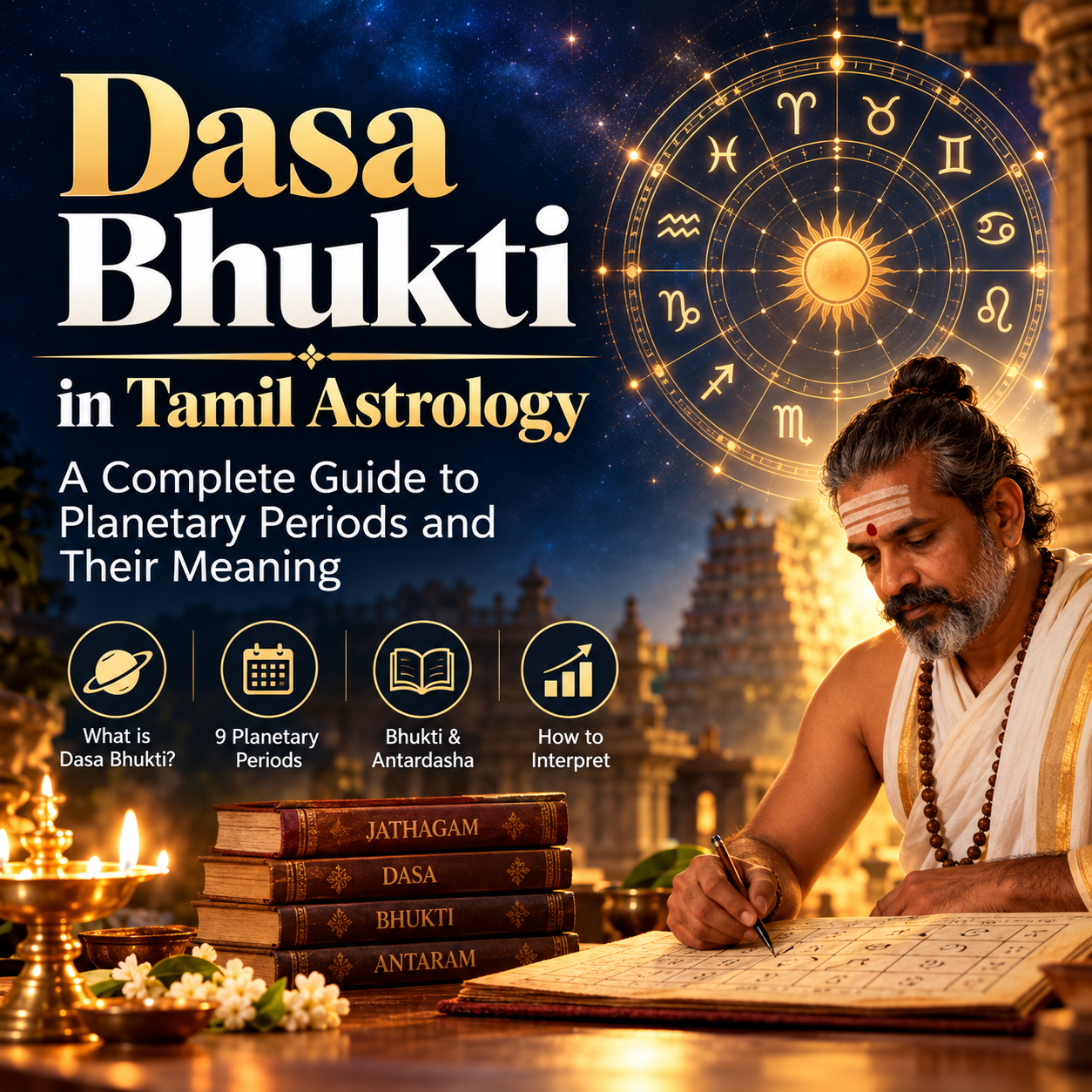
Dasa Bhukti in Tamil Astrology: A Complete Guide to Planetary Periods and Their Meaning
When people consult an astrologer about marriage, career, business, finances or family life, they often hear terms such as Dasa, Bhukti and Dasa Bhukti Palan.
Questions like “Which Dasa am I currently running?”, “Is Saturn Dasa always difficult?”, “What does Guru Dasa mean?” and “How does Rahu Bhukti affect my horoscope?” are common among people who follow Tamil astrology.
Dasa Bhukti is an important concept in traditional Vedic astrology. It refers to planetary periods and sub-periods that astrologers use to interpret different phases of a person's life.
In this guide, we explain the meaning of Dasa Bhukti, the nine planetary periods, the difference between Dasa and Bhukti, the role of birth stars, and how astrologers interpret Dasa Bhukti Palan in a horoscope.
1. What Is Dasa Bhukti?
In Vedic astrology, Dasa refers to a major planetary period, while Bhukti refers to a sub-period within that major period. Bhukti is also commonly called Antardasha.
For example, a person may be undergoing Guru Dasa, within which Saturn Bhukti or Venus Bhukti may occur.
- Mahadasha: The major planetary period.
- Bhukti or Antardasha: A sub-period within the Mahadasha.
- Pratyantardasha: A smaller period within the Bhukti.
Astrologers interpret these periods alongside the planetary positions in the birth chart, house ownership, planetary aspects and other relevant factors.
In Tamil, these terms are commonly referred to as Dasa (தசை), Bhukti (புத்தி) and Antaram (அந்தரம்).
2. What Is Vimshottari Dasa?
Vimshottari Dasa is one of the widely used planetary-period systems in Vedic astrology, including many Tamil astrology practices.
It follows a cycle of 120 years, distributed among nine planetary rulers. In this system, a person's starting Dasa is determined by the birth star (Janma Nakshatra) and the Moon's position within that star at birth.
| Planet | Dasa Period |
|---|---|
| Ketu | 7 years |
| Venus (Shukra) | 20 years |
| Sun (Surya) | 6 years |
| Moon (Chandra) | 10 years |
| Mars (Mangala) | 7 years |
| Rahu | 18 years |
| Jupiter (Guru) | 16 years |
| Saturn (Shani) | 19 years |
| Mercury (Budha) | 17 years |
| Total | 120 years |
These durations belong specifically to the Vimshottari Dasa system. Not every astrological tradition uses the same method for calculating planetary periods.
3. Understanding the Nine Planetary Dasas
In traditional astrology, each planet is associated with certain themes and areas of life. However, the interpretation of a planetary period depends on the complete birth chart rather than the planet's name alone.
Ketu Dasa
Ketu is traditionally associated with spirituality, introspection, detachment and inner exploration. Its interpretation depends on its placement and connections within the birth chart.
Venus Dasa (Shukra Dasa)
Venus is associated with relationships, marriage, beauty, comforts, artistic interests and material pleasures. Astrologers consider Venus's placement, house ownership and planetary relationships when interpreting this period.
Sun Dasa (Surya Dasa)
The Sun is traditionally associated with leadership, authority, confidence, responsibility and government-related matters.
Moon Dasa (Chandra Dasa)
The Moon is associated with emotions, the mind, family, the mother and everyday experiences.
Mars Dasa (Mangala Dasa)
Mars is associated with courage, action, competition, energy, land and siblings.
Rahu Dasa
Rahu is traditionally associated with ambition, unconventional experiences, foreign connections, technology and strong desires.
Jupiter Dasa (Guru Dasa)
Jupiter is associated with knowledge, education, guidance, children, spiritual development and expansion.
Saturn Dasa (Shani Dasa)
Saturn is associated with discipline, patience, responsibility, hard work, delays and long-term effort. Saturn Dasa should not automatically be interpreted as a period of hardship.
Mercury Dasa (Budha Dasa)
Mercury is associated with communication, learning, business, analytical ability, mathematics and intellectual activities.
Important: These are traditional astrological associations, not scientifically established predictions. A planet's name alone cannot determine whether a period will be favourable or unfavourable for an individual.
4. What Is the Difference Between Bhukti and Antardasha?
Bhukti and Antardasha generally refer to the same sub-period within a Mahadasha.
Each Mahadasha contains a sequence of sub-periods ruled by the nine planetary lords. The major-period ruler and the sub-period ruler are considered together when interpreting a horoscope.
For example, consider Guru Dasa – Saturn Bhukti:
- Jupiter is the ruler of the major period.
- Saturn is the ruler of the sub-period.
- An astrologer examines the positions, house ownership and relationships of both planets in the birth chart.
Similarly, combinations such as Saturn Dasa–Venus Bhukti or Rahu Dasa–Mercury Bhukti may be interpreted by considering both planetary rulers and the overall horoscope.
The interpretation is not based on the planetary names alone. The complete chart and the calculation method also matter.
5. How Does the Birth Star Determine Dasa?
The birth star, or Janma Nakshatra, plays an important role in calculating Vimshottari Dasa.
The Moon's position at the time of birth determines the starting planetary period and the remaining duration of that period.
This means that two people born under the same zodiac sign may begin life with different Dasa periods. Their birth stars, exact birth times and the Moon's position within the respective stars can produce different calculations.
Accurate birth details are therefore important when calculating a horoscope and determining the current Dasa and Bhukti.
The required details generally include:
- Date of birth
- Time of birth
- Place of birth
Differences in birth-time accuracy or calculation settings may affect the resulting horoscope and Dasa timeline.
6. How Do Astrologers Interpret Dasa Bhukti Palan?
Dasa Bhukti Palan refers to the traditional interpretation of the results associated with a particular planetary period and sub-period.
Astrologers commonly consider several factors together:
- Mahadasha lord: The placement of the major-period planet, the houses it rules and its relationships with other planets are examined.
- Bhukti lord: The sub-period planet is assessed in relation to its position, house ownership and connections with the Mahadasha lord.
- Ascendant and houses: The ascendant (Lagna) and the houses associated with career, marriage, finances, family and other life areas are considered.
- Planetary aspects and conjunctions: Astrologers examine planetary aspects, conjunctions and other relationships that are part of the chosen interpretive tradition.
- Planetary transits: Current planetary transits, known as Gocharam in Tamil astrology, may also be considered alongside Dasa Bhukti.
- Calculation method: The Dasa system, birth-chart calculation settings and astrological tradition used can influence the interpretation.
Considering these factors together provides a more complete traditional astrological reading than relying on a single planetary period.
7. Is Saturn Dasa Always Difficult?
One of the most common questions in Tamil astrology is whether Saturn Dasa always brings difficulties.
The answer within traditional astrological interpretation is no. Saturn Dasa is not considered uniformly negative for everyone. Its interpretation depends on Saturn's position in the birth chart, the houses it rules, its relationships with other planets and the Bhukti operating within the period.
Likewise, Rahu Dasa is not automatically unfavourable, and Guru Dasa is not guaranteed to bring success.
It is better to avoid making major personal, financial or professional decisions based solely on the name of a Dasa or a general prediction. Astrology should not replace practical judgement or qualified professional advice.
8. What Information Is Needed to Calculate Dasa Bhukti?
To calculate Dasa Bhukti using a birth-chart system, the following information is generally required:
- Date of birth: The person's birth date.
- Time of birth: As accurately recorded as possible.
- Place of birth: The town or city where the person was born.
- Calculation settings: The relevant Dasa system and horoscope calculation conventions.
If the birth time is inaccurate, the calculated chart or timing may differ, depending on the circumstances and calculation method.
Once the birth details are entered into a suitable horoscope calculator, the resulting Dasa timeline can help identify the major period and sub-period according to that system.
9. Frequently Asked Questions About Dasa Bhukti
What is the meaning of Dasa Bhukti?
Dasa Bhukti refers to a major planetary period and its sub-period in traditional Vedic astrology. These periods are interpreted in relation to the person's birth chart.
Are Dasa and Bhukti the same?
No. Dasa usually refers to the major planetary period, while Bhukti refers to a sub-period within it. Bhukti is also commonly called Antardasha.
How long does a Dasa last?
The duration depends on the planetary ruler and the Dasa system being used. In Vimshottari Dasa, the nine planetary periods range from 6 years for the Sun to 20 years for Venus.
Does the birth star determine Dasa?
In the Vimshottari system, the birth star and the Moon's position within it are used to determine the starting Dasa and its remaining duration.
Is Guru Dasa always favourable?
Not necessarily. Traditional astrologers interpret Guru Dasa by examining Jupiter's position, house ownership, planetary relationships and the overall birth chart.
Is Saturn Dasa always bad?
No. Saturn Dasa is not interpreted identically for everyone. Its traditional interpretation depends on the full horoscope and the sub-periods within the Dasa.
What is Dasa Bhukti Palan?
Dasa Bhukti Palan means the interpretation of the effects or results associated with a particular planetary period and sub-period in a horoscope.
Is Dasa Bhukti scientifically proven?
Dasa Bhukti is a traditional astrological system. There is no robust scientific evidence establishing that planetary periods can reliably predict individual life events. Readers may approach it as part of cultural, spiritual or astrological tradition.
Conclusion
Dasa Bhukti is an important concept in Tamil astrology and the broader Vedic astrological tradition. Understanding Dasa, Bhukti, Antardasha, birth stars and planetary periods can help readers make sense of the terminology used in traditional horoscope interpretations.
However, the name of a planetary period alone is not enough to determine whether a particular phase will be favourable or unfavourable. Traditional interpretations consider the complete birth chart and the calculation system being followed.
AstroSEVA helps readers explore Tamil astrology, horoscope calculations and Panchangam-related information, making traditional astrological concepts easier to understand.